

Can Indian Students Really Study Abroad Under ₹5 Lakhs? A Low Budget Study Abroad Guide
Studying abroad doesn’t always require a ₹20–40 lakh budget. With the right planning, destination, and program selection, Indian students can study internationally for under ₹5 lakhs per year sometimes even less.
And as more universities adopt hybrid formats, offer scholarship-heavy programs, and keep tuition costs lower for international students, global education is becoming accessible to middle-class Indian families.
This guide brings you fresh data, practical examples, and research-backed pathways to achieve a budget-friendly international degree without compromising quality.
Study Abroad Cost Reality for Indian Students (Latest Data)
According to UNESCO & Indian government data:
- USA & UK account for over 55% of Indian outbound students
- Average cost:
- USA: ₹35–45 lakhs
- UK: ₹25–35 lakhs
- Germany/Poland/Malaysia: ₹6–12 lakhs total
- Over 38% of Indian students now prefer Europe & Asia due to affordability (2024 trend)
Why Low-Budget Study Abroad Is Growing (2025 Trend)
- The rising cost of traditional destinations (USA, UK, Australia) is pushing students to explore affordable but high-quality alternatives.
- Hybrid and blended programs allow students to complete core coursework online and travel abroad only for short, mandatory practical sessions, significantly reducing overall living expenses.
- Affordable destinations (several in Europe, Asia and Latin America) now offer English-taught programs with low tuition and reasonable living expenses.
- Scholarships and government grants aimed at international students have expanded in many countries.
- Remote internships and part-time work help students offset living costs while studying.
- Credit transfers and twinning programs allow students to complete part of a degree at a low-cost local partner and finish the rest abroad
- Countries like Germany, France, Taiwan, Turkey, Mexico, UAE, Poland, and Latvia now promote low-fee international student policies.
Who should consider a low-budget route?
- Students from middle-income families who want global exposure without major debt.
- Working professionals pursuing part-time or hybrid master’s degrees.
- Undergraduates open to twinning programs (start local, finish abroad).
- Students wanting niche skills (tech, hospitality, healthcare) where program quality is high and tuition is low.
If you value learning outcomes more than the brand name on the diploma, a low-budget path can be the smartest ROI.
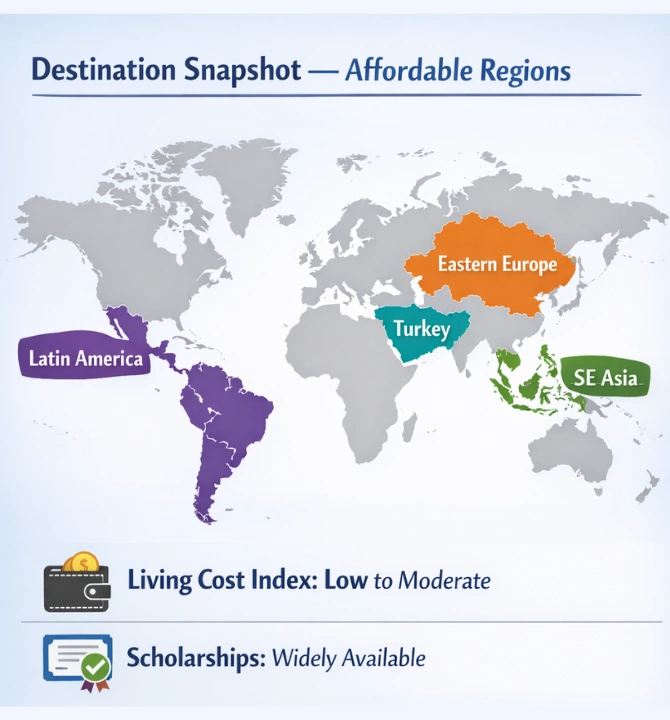
Top affordable destinations for Indian students (models, not promises)
Below are destination models popular with cost-conscious students. Exact fees vary by university, city and program; use these as starting points.
- Germany (public universities): Many state universities charge little or no tuition for international students; living costs depend on city but can be far lower than in North America. Hybrid options and DAAD scholarships further reduce costs.
- Poland / Latvia / Portugal (smaller EU markets): Low tuition for English-taught programs and lower living costs in non-capital cities make these attractive.
- Malaysia / Taiwan / Mexico: Good English programs, lower tuition than western countries, and decent part-time work opportunities.
- Turkey: Several fully funded scholarships exist (nationwide), and many public universities have modest fees.
- Hybrid paths to UK/Australia: Start online or at a partner campus in a cheaper country, then transfer to the main campus for one year (reduces total living cost).
In-Demand Programs That Fit a Low Budget
Selecting the right subject matters. These programs are high-ROI and commonly available in affordable markets:
- Computer Science / Data Analytics / IT – Germany, Poland, Malaysia
- Nursing & Healthcare – Turkey, Poland
- Business & Management – Malaysia, Poland
- Hospitality & Tourism – Malaysia, Turkey
- Engineering – Germany, Turkey
Choosing a field with clear employability increases the chance that scholarships, internships and part-time work will offset costs.
Scholarship Opportunities
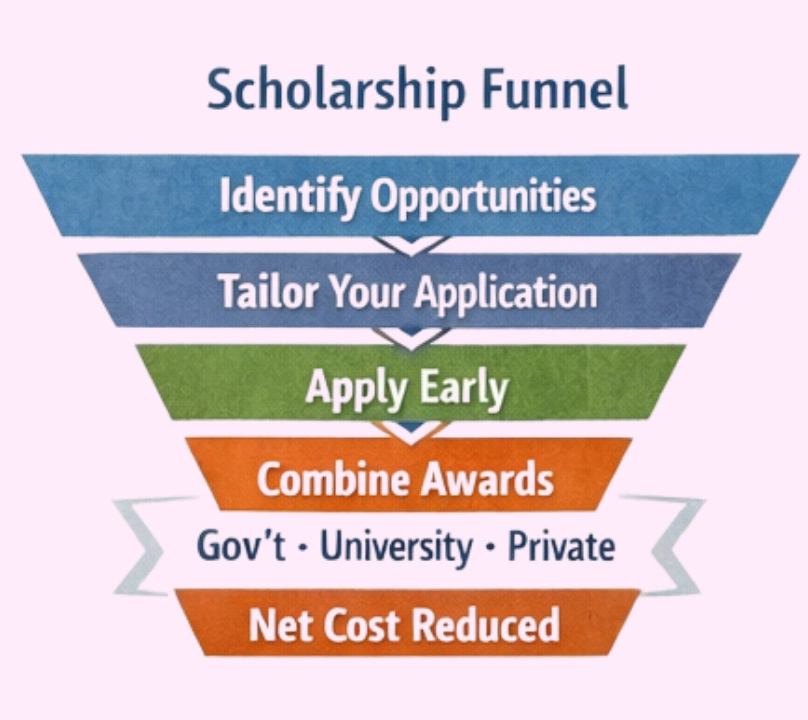
Scholarships are a major game changer. There are three useful funding buckets:
- Government scholarships (country or embassy funded) — often provide tuition support and a monthly stipend.
- University-funded scholarships and bursaries are awarded based on merit or financial need, with many institutions setting aside dedicated funds specifically for international students.
- Private and philanthropic funding options include support from foundations, corporate sponsors, and country-specific aid programs—often designed to assist students from developing nations.
Government Scholarships
- DAAD (Germany) – full/partial stipends
- NAWA (Poland) – grants
- Malaysia International Scholarship – tuition + allowance
- Turkiye Burslari – full funding
- Charpak Scholarship (France)
- Taiwan MOE
- VLIR-UOS (Belgium)
- Erasmus+
- Commonwealth (UK — hybrid applicable)
- Campus France Bursaries
Private Scholarships for Indian Students
- Tata Trust
- KC Mahindra
How to Reduce Costs Even Further
1. Start with Hybrid Learning / Twinning Programs
Hybrid education cuts expenses dramatically.
Why it works
- Study 6–12 months online from India (saves on living expenses).
- Shift abroad only for essential semesters.
- Visa processing becomes easier with shorter mobility periods.

2. Target Public Universities
In Europe, public universities are heavily subsidized.
Countries where public tuition is the cheapest:
- Germany
- France
- Norway
- Austria
- Italy
Research Insight
Students in public universities in Europe pay 70–90% less than students in private universities in the same country.
3. Choose Economical Cities, Not Capital Cities
Living costs are significantly higher in capital cities like Paris than in smaller towns. Your living cost can drop by choosing universities in smaller towns.
Cheap cities:
- Poland: Lublin, Bialystok
- France: Lille, Clermont-Ferrand
- Germany: Dresden, Leipzig
- Canada (partial): Regina, Winnipeg
- UK (hybrid model): Birmingham, Coventry
4. Work-While-Studying to Offset Living Costs
Most countries allow students to work part-time (e.g., up to 20 hours/week in Denmark and Germany), which can substantially cover monthly expenses.
5. Cook at Home and Share Housing
The most significant living cost is often accommodation and food. Sharing an apartment with roommates and cooking your own meals can save hundreds of rupees monthly.
6. Utilize Student Discounts
Take advantage of student discounts on transportation, museums, cinemas, and other activities.
By planning smartly and focusing on countries with inherently low education costs, global education is an attainable goal on a low budget.
Step-by-step checklist
- Pick your field (CS, business, healthcare, hospitality).
- Choose countries based on real costs
- Shortlist 6 programs (mix hybrid / twinning / low tuition).
- Identify 5 scholarships and note deadlines.
- Prepare core docs: transcripts, SOP, CV, references.
- Build a conservative 2-year budget with a 10% contingency.
- Maintain part-time eligibility
Common mistakes that ruin budgets
- Applying late — you miss scholarships and early application perks.
- Choosing capital cities only — rent and food in capitals can double prices.
- Assuming hybrid = low quality — poor course design wastes money; check learning outcomes.
- Not verifying credit transfer rules — some local credits don’t map to overseas degrees.
- Poor budgeting
Avoid these and your budget stays intact.
FAQ
1. Can Indian students really study abroad under ₹5 lakhs?
Yes, Indian students can study abroad under ₹5 lakhs per year in selected countries and programs.
This is possible through:
- Public universities with low or zero tuition fees
- Hybrid and twinning programs (study partly from India)
- Government and university scholarships
- Choosing non-capital cities with lower living costs
Many Indian students now complete internationally recognized degrees in Germany, Poland, Malaysia, Turkey, and Latvia without taking heavy education loans.
2. Which countries are cheapest for Indian students in 2025?
Some of the most affordable study abroad destinations for Indian students in 2025 include:
- Germany – Public universities with minimal tuition
- Poland & Latvia – Low tuition + affordable living
- Malaysia – Budget-friendly English-taught programs
- Turkey – Government-funded scholarships available
- Taiwan & Mexico – Growing low-fee international policies
These countries offer a high ROI education compared to traditional destinations like the USA, UK, or Australia.
3. Are low-budget degrees accepted in India and abroad?
Yes. Low-budget does NOT mean low quality.
Degrees from government-recognized universities in Europe and Asia are:
- Accepted by employers worldwide
- Valid for further studies
- Recognized for global job markets
The key is to ensure:
- University is government-approved
- Degree follows Bologna / international education frameworks
- Proper documentation and credit transfer
This is where expert counseling becomes crucial.
4. Do hybrid master’s degrees affect visa approval?
No, hybrid master’s degrees do not negatively affect visa approval when:
- The program is officially recognized
- Physical attendance requirements are clearly defined
- The visa is applied for the on-campus phase
In fact, hybrid degrees often:
- Reduce financial risk
- Improve visa clarity
- Make study plans more realistic for Indian students
Countries like Germany, UK, Australia, and parts of Europe actively support hybrid education models.
5. Is part-time work enough to manage living expenses abroad?
In many countries, part-time work can cover a large portion of monthly living expenses, especially when combined with:
- Shared accommodation
- Student discounts
- Smart budgeting
For example:
- Germany, Poland, and Malaysia allow legal part-time work
- Students often earn enough to cover rent, food, and transport
However, part-time income should be seen as support, not the sole funding source.
Final thoughts: strategy over spending
A low-budget study-abroad route isn’t inferior; it’s strategic. Prioritize program quality, real-world skills, and funding mix. When you combine hybrid design, careful destination choice, scholarships and conservative budgeting, international education can be affordable and career-transforming.
At MAK Consultants, we help students:
- Find the best programs
- Identify hybrid + twinning degree options
- Secure scholarships
- Understand visa rules and affordability
- Get admission + SOP + documentation support
- Build a financial/ROI roadmap
Your global journey can start today — without a massive financial burden.