

Major Student Visa Policy Updates Indian Students Must Know Before Studying Abroad in 2025-26
For many international students, a visa is the golden ticket to fulfilling their study abroad dream. But in 2025, several governments have introduced new rules, tighter checks, and digital updates that every applicant must understand before applying. Major destination countries are continuing to reform their student visa pathways, driven primarily by goals of enhancing program integrity, controlling migration numbers, and ensuring that international students are genuine.
If you’re planning your global education journey, this guide will walk you through the most important student visa policy updates, backed by data, examples, and practical tips.
Why Student Visa Updates in 2025 Matter
- According to UNESCO, over 6.5 million students are studying abroad in 2025, and Indian students make up one of the fastest-growing groups.
- Visa rejections have risen by 15–20% in key destinations like the U.S. and U.K., highlighting the importance of staying informed.
- Digitalization and stricter “genuine student” requirements are reshaping the visa process worldwide.
In short: ignoring policy updates could mean delays, refusals, or even bans.
The United States: Enhancing Program Oversight
While the fundamental F-1 visa process remains stable, the U.S. is increasing oversight, particularly concerning work authorization programs.
1. Increased Scrutiny on OPT and CPT
There is heightened monitoring of Curricular Practical Training (CPT) and Optional Practical Training (OPT) programs to combat fraud.
- Designated School Official (DSO) Role: DSOs at universities are under pressure to rigorously verify that CPT activities are integral to the curriculum and that OPT employment is directly related to the student’s field of study. Students must be prepared to fully justify their work placements.
While processing has improved since the pandemic, students should continue to apply well in advance, as security clearances and administrative processing times for some applicants can still cause significant delays.
3. STEM OPT Extension Remains Strong
The STEM Optional Practical Training (OPT) extension is still available, allowing qualified graduates in Science, Technology, Engineering, and Mathematics (STEM) fields to work in the U.S. for up to 36 months (3 years) after graduation. This provides invaluable work experience and a substantial return on investment.
4. Stricter Visa Interviews
- Career Clarity: Applicants must show how their U.S. degree connects to a clear career path in their home country. Generic answers won’t work—be specific with roles, companies, and industries.
- Home-Country Ties: Strong financial, social, and family ties must be demonstrated to counter suspicions of long-term immigration intent.
5. Mandatory Social Media Disclosure
- Applicants must now share social media handles from the last five years on the DS-160 form.
- Tip: Keep online profiles professional and align with your stated study and career goals.
The United Kingdom: The Integrity Crackdown
The UK continues its focus on tightening the Student Route visa to tackle perceived misuse. Applications in 2025 will face increased scrutiny under two primary areas:
1. Enhanced Genuine Student (GS) Requirements
- The Genuine Student (GS) rule has replaced the old Genuine Temporary Entrant (GTE) system.
- Visa officers are now specifically trained to assess whether the student’s primary purpose is genuinely academic.
- Mandatory interviews are more common for high-risk applicants or those with education gaps.
- A strong Statement of Purpose linking past studies to future career plans is crucial.
2. Dependent Restrictions
- Most postgraduate taught students can no longer bring dependents.
- Only PhD and research-based master’s students are exempt.
3. Graduate Route Review
While the two-year Graduate Route (post-study work visa) remains in place, there is ongoing political discussion and review. Students should monitor any news regarding changes to its eligibility criteria or duration, though significant changes are unlikely without prior notice.
Detentions & Declines Rising: Reports show a 12% increase in visa detentions for fraudulent documentation. Tighter checks mean more refusals and detentions in 2025:
- Visa Refusals: Applications are rejected if officers doubt a student’s academic intent or financial readiness, which can also affect future applications to other countries.
- Border Detentions: Even with a visa, students risk being stopped or deported if the Border Force suspects fraud, missing documents, or weak knowledge about their course.
Canada: Managing the Growth and Quality Control
Canada, still a highly popular destination, has implemented policies to stabilize its international student ecosystem following a period of unprecedented growth.
1. Study Permit Cap & PALs
Canada has introduced a national cap on new study permits for 2025. Now, most undergrad and non-degree graduate applicants must first obtain a Provincial Attestation Letter (PAL) before applying for a federal study permit.
- Impact: This new step can delay timelines and create bottlenecks, making early planning essential.
2. Post-Graduation Work Permit (PGWP) Eligibility Changes
Eligibility for the Post-Graduate Work Permit (PGWP) is now stricter. Graduates of programs delivered via public-private curriculum licensing agreements (often leading to a private college diploma) are no longer eligible for the PGWP. This change focuses on directing students toward fully accredited public institutions.
3. Financial Proof Requirement
Canada increased the required financial proof for new study permit applications – Applicants must now show CAD $20,635 in living expenses, up from $10,000.
Australia: Raising the Bar for Integrity
Australia has continued its migration overhaul to ensure high-quality, genuine student applications, primarily through stricter testing and application requirements. Key updates include:
1. Genuine Student Test (GST)
Students must demonstrate a clear understanding of the course, their career goals, and how the qualification will be used for post-graduation. The focus is explicitly moving away from applicants stating permanent residency as a primary motivation.
2. Increased Financial and English Requirements
The Australian government has raised the required minimum amount of funds students must demonstrate to cover living costs, reflecting the current cost of living. Furthermore, some universities are introducing higher minimum English Language requirements, requiring better scores on tests like IELTS or TOEFL
3. Extended Post-Study Work Rights:
The Australian government extended post-study work rights for international graduates with degrees in high-demand sectors, such as healthcare and IT, potentially granting them up to 4 – 6 years of work rights, depending on their degree level
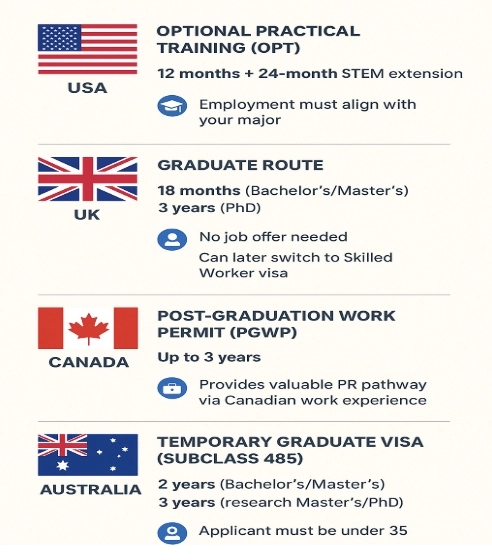
Post-Study Work Opportunities by Country
| Country | Program/Visa Name | Duration | Key Conditions |
| USA | Optional Practical Training (OPT) | 12 months, with an additional 24-month extension (3 years total) for STEM degrees. | Your field of employment must align with your major field of study. The STEM OPT extension is available. |
| UK | Graduate Route | 18 months for Bachelor’s & Master’s degrees, 3 years for PhD graduates. | The graduate visa is unsponsored, no job offer is needed from a licensed employer to stay. It is switchable to a Skilled Worker visa. |
| Canada | Post-Graduation Work Permit (PGWP) | Up to 3 years, depending on the length of your study program. | >2 years programs & Masters, you may be eligible for a 3-year PGWP; permanent residency pathway. |
| Australia | Temporary Graduate Visa (subclass 485) | 2–3 years, depending on your qualification. | Duration is tiered by degree; The age limit for most applicants is 35. |
What These Changes Mean for Indian / International Students
- Be ready to show stronger proof of finances, not just minimum tuition but also living costs, sometimes higher than before.
- Expect visa application delays or extra steps (social media checks, interviews). Apply earlier.
- If you had plans to bring dependents (spouse, children), double-check whether your course supports that. UK is tightening in that area.
- For work after studies, policies are shifting—some countries are more restrictive or tying PGWP/work-permit eligibility to specific fields of study. Make sure your planned course aligns.
- Higher fees and living cost minimums mean budgeting needs to be more detailed and realistic.
Case Study: Indian Student Visa Rejections in 2024
- U.S.: Over 1 in 4 Indian visa applications faced rejection.
- UK: Detention cases increased due to fraudulent financial documents.
- Canada: Thousands delayed due to new intake caps.
The lesson? Strong documentation and genuine intent are more important than ever.
Final Thoughts
Visa policies in 2025 are evolving faster than ever. Stricter checks, higher financial thresholds, and growing rejections mean students must prepare with absolute care. But with the right planning, transparent documentation, and strong guidance, your study abroad dream is still very much within reach.
At MAK Consultants, we specialize in end-to-end support—right from university selection to visa guidance, scholarships, and post-arrival support. If you want to minimize risks and maximize your chances of success, now is the time to act.
Start your 2025 study abroad journey with us today, schedule a free consultation and get personalized visa guidance.