

Why NEP 2020 is Changing and How Indian Students Plan Their Study Abroad Journey
Every year, thousands of Indian students dream of studying abroad but new education reforms like NEP 2020 are changing how this journey begins. From credit transfers to new university tie-ups, students must adapt fast to avoid missing opportunities.
How India’s New Education Policy is Reshaping Study Abroad Trends
For decades, Indian students have been a dominant force in the global study abroad landscape. The traditional path often involved completing a degree in India and then heading overseas for a master’s or Ph.D. However, with the introduction of the National Education Policy (NEP) 2020, this narrative is beginning to evolve.
The National Educational Policy (NEP) 2020 isn’t just a set of academic reforms; it’s a fundamental shift in philosophy. By introducing flexibility, a multidisciplinary approach, and new academic structures, it’s not only preparing students for the global stage but also directly influencing how they choose to engage with international education.
So, what are the keyways the NEP is impacting study abroad?
1. How NEP’s Flexible Programs Prepare Indian Students for Global Universities
One of the cornerstones of the NEP is its focus on moving away from rigid academic streams. A student who previously had to choose between science, commerce, or arts now has the flexibility to pursue a mix of subjects, such as physics with music or chemistry with economics. This is a game change.
Impact on Study Abroad:
- Many top universities abroad already have a flexible, liberal arts-style curriculum.
- The NEP is essentially preparing Indian students to thrive in these environments to align them better with international education systems.
- Admissions officers abroad are noticing the well-rounded skill sets NEP-educated students bring.
2. How Academic Bank of Credits (ABC) Makes Studying Abroad Easier
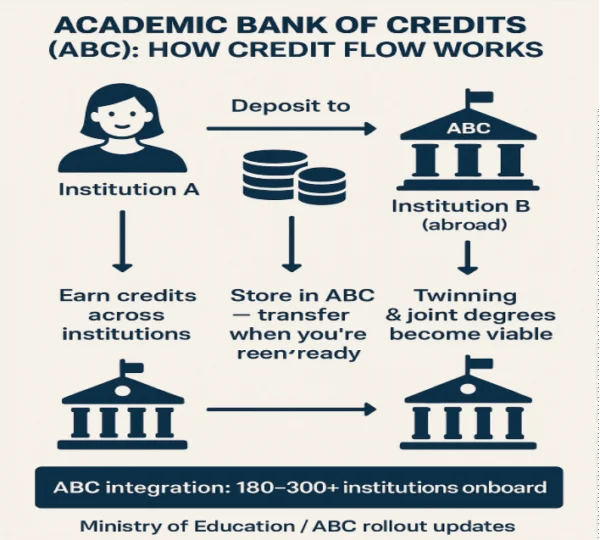
Perhaps the most significant change impacting study abroad is the introduction of the Academic Bank of Credits (ABC). This innovative feature allows students to accumulate academic credits from different institutions and transfer them toward a single degree.
In practical terms, it means Indian students may soon find it easier to:
- Enables credit transfers between Indian and foreign universities.
- Simplifies twinning programs—start in India, finish abroad.
- Encourage student exchange programs and dual degree partnerships.
- Lower costs and faster pathways to global degrees.
For students dreaming of an international education, the ABC simplifies and creates a seamless pathway for a “twinning program,” where a student can complete part of their degree at an Indian institution and the rest at a university abroad. This kind of academic mobility is now easier and more formal than ever before.
As per India’s Ministry of Education, over 300+ universities are now linked to ABC, paving the way for future international collaborations.
Example:
An engineering student can now complete two years in India, transfer their credits via ABC, and finish the final two years in the UK or Canada, saving both time and tuition costs.
Worried about selecting the right country. Read our full blog on How to Choose the Right Country for your Study Abroad Education
3. Skill-Based Learning: How NEP 2020 Builds Global Career Readiness
The NEP places a strong emphasis on vocational education and hands-on experience, starting as early as middle school. This focus on practical skills aligns well with the practical and experiential learning models used by many international universities, particularly those in STEM, design, and business.
As Indian universities adopt these changes, students are likely to be better prepared for research-intensive programs abroad.
By valuing internships, skill-based courses, and project-based learning, the NEP is producing graduates who are not only academically strong but also possess the practical skills that employers and international admissions committees are looking for.
This shift could lead to an increase in applications for postgraduate and doctoral programs in countries like the USA, UK, Canada, and Germany.
4. Foreign University Campuses in India, A Game Changer for Students
A bold feature of the NEP 2020 also allows top foreign universities to establish campuses in India. This is a crucial point of change. While some might see this as a threat to the study abroad trend, it’s more likely to expand access to a global-standard education.
Possible Outcomes:
- Students can pursue foreign degrees locally at reduced costs without leaving India.
- These campuses may act as bridges that students can complete part of their studies in India and transfer abroad.
- Boosts international collaboration and faculty exchange.
In 2024, Australia’s Deakin University and Wollongong University were the first overseas universities to establish campuses in India’s GIFT City in Gujarat.
5. Skill Development and Global Employability
NEP 2020 highlights 21st-century skills such as:
- Problem solving
- Digital literacy
- Multilingual communication
Why It Matters:
- These are the top competencies sought by global employers.
- Graduates trained under NEP’s skill-focused framework will transition smoothly into international workplaces.
- Encourages students to pursue global internships and cross-border career opportunities.
6. The Financial Perspective
One major driver for studying abroad has always been perception: foreign universities are seen as higher quality and more career-enhancing.
NEP 2020 attempts to narrow that gap by improving:
- Curriculum quality
- Faculty training
- Research standards
Over time, if Indian universities gain credibility under NEP reforms,
- Cost-conscious families might opt for strong Indian universities or foreign branch campuses.
- Global aspirants will use NEP’s credit system and skill exposure to pursue advanced degrees abroad more effectively.
7. Impact on Popular Study Destinations
Thanks to NEP 2020, Indian students are becoming more diverse in their study choices. While traditional destinations like the USA, UK, Canada, and Australia remain top picks, there’s a growing interest in countries offering affordable education, credit transfer options, and skill-based programs such as
- Germany – Free or low-cost education with credit recognition
- Ireland – High employability programs
- Dubai & Singapore – Proximity and multicultural exposure
Planning to study in Dubai. Get a complete picture by reading our blog: 2025 Guide on Study Abroad in Dubai for Indian Students
8. Possible Shifts in Motivation
Traditionally, studying abroad has been as much about migration opportunities as it has been about education. NEP 2020, with its globalized outlook, bridging the gap between Indian and international education systems, ensuring students are:
- More adaptable
- Skill-oriented
- Globally employable
Whether students pursue higher education domestically or abroad, NEP 2020 ensures the Indian education system speaks the same academic language as the rest of the world.
Quick Stats: What the Numbers Say
- 1.33 million Indian students studied abroad in 2024, up from 0.93M in 2023 — a sharp rise in global mobility. Official MEA Source
- ABC platform scale: 22.7 crore APAAR IDs issued, and 1,847 awarding institutions registered (MoE dashboard, 2025). abc.gov.in
- Cost advantage: Twinning & credit transfer programs can reduce total expenses by 30–60% vs. full overseas study. Study Overseas Source
- Important: Poor credit transfer can cost students an extra $13,000–$26,000 in tuition. CHEPP Research
Frequently Asked Questions (FAQs)
- Will NEP 2020 make studying abroad cheaper for Indian students?
Yes, NEP 2020 introduces credit transfer and twinning programs that let students complete part of their degree in India and the rest abroad. This can cut tuition and living costs by 30–50%, making international education more affordable.
- Can I transfer my Indian university credits to a foreign university?
Yes. Through the Academic Bank of Credits (ABC), students can transfer eligible credits to partner universities abroad. Many institutions in the UK, Canada, and Australia are open to these credit pathways.
- Which countries are best for Indian students under NEP’s new reforms?
Top choices include Canada, the UK, Germany, Ireland, Dubai, and Singapore. These countries offer credit transfer options, skill-based programs, and good post-study work opportunities.
- Will foreign universities set up campuses in India?
Yes. Under NEP 2020, leading global universities can open Indian campuses. This gives students access to foreign degrees at lower costs, with the option to transfer abroad later.
- How will NEP 2020 help me get a global job after graduation?
NEP focuses on 21st-century skills like problem-solving, digital literacy, and communication. These are exactly what international employers look for, giving students an edge in the global job market.
- Do I still need to take exams like IELTS or TOEFL?
Yes. While NEP reforms make the academic transition smoother, language proficiency tests like IELTS or TOEFL are still required for admission to most foreign universities.
- How can I know if my course or university is eligible for credit transfer?
You can check your eligibility through the ABC portal or consult a study abroad expert who can guide you on university partnerships and twinning program options.
Final Thoughts
India’s NEP 2020 is a transformative policy that is redefining the way students learn, plan careers, and explore the world. For study abroad aspirants, it opens new doors making education more flexible, globally connected, and skill focused.
As more Indian students prepare for international education, the trends will shift toward countries and programs that value research, innovation, and employability.
How We Can Help You
At MAK Consultants, we guide students through every stage of their study abroad journey, from career counseling and university shortlisting to application management, scholarship support, visa processing, and post-arrival support.
Here’s how we help you succeed:
- Personalized study abroad roadmap aligned with NEP-based skill development
- Expert assistance for credit transfers and twinning programs
- Guidance on choosing countries that value NEP competencies
- 360° support for admissions, funding, and pre-departure planning

Don’t let the NEP 2020 transition slow down your study abroad goals. Book a free consultation with MAK Consultants today and get your personalized study abroad roadmap today.